Hassan II Mosque History: From Construction to Icon
Quick answer
King Hassan II commissioned the mosque to mark his 60th birthday, and construction ran from 1986 to 1993 under French architect Michel Pinseau, blending traditional Moroccan craftsmanship with modern engineering like a retractable roof.
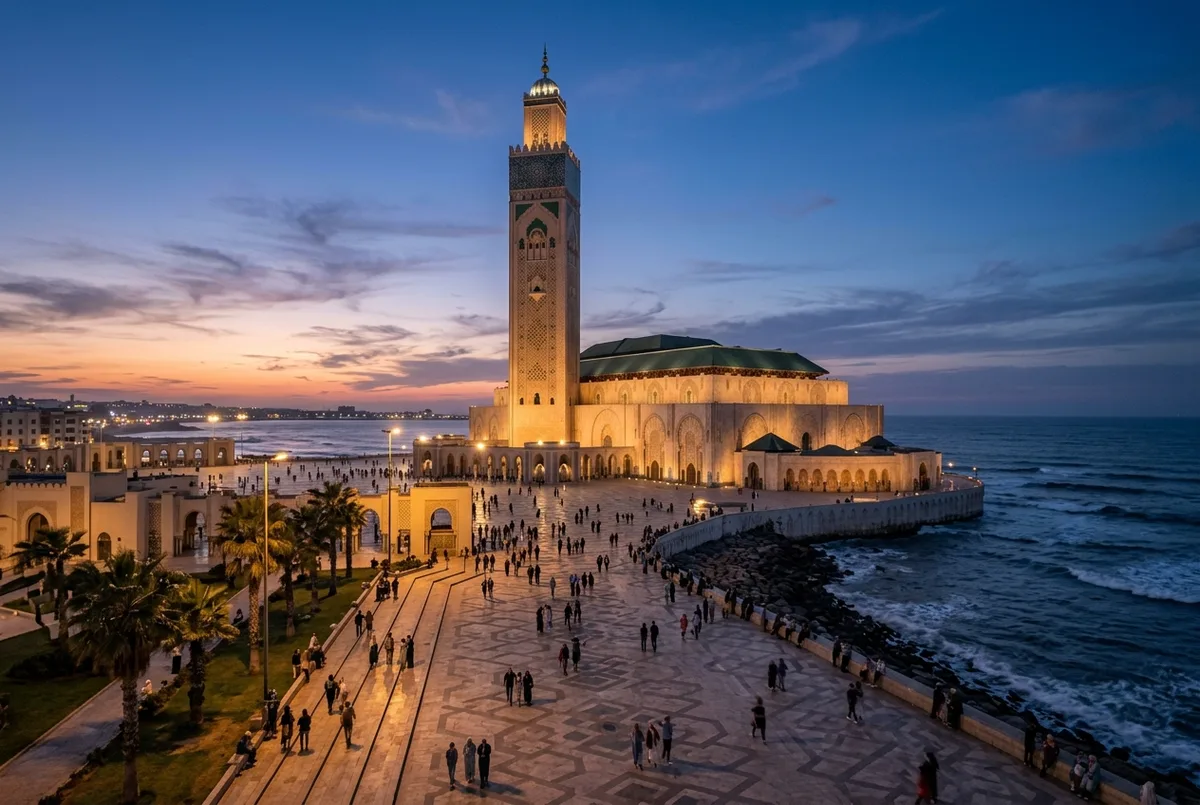
Hassan II Mosque history begins with a birthday gift on a scale almost no other building in the world can match: King Hassan II commissioned the mosque to mark his 60th birthday, and asked for it to be built partly over the Atlantic Ocean, so that his people could pray with the sea beneath them. Construction ran from 1986 to 1993 under French architect Michel Pinseau, and the result remains Casablanca’s defining landmark more than three decades later.
This guide covers the fuller timeline, why the mosque was built at all, and what makes it historically significant beyond its size. For readers who want to go deeper on any single thread, the design itself, the cost, and its ranking among the world’s largest mosques each get a dedicated breakdown linked throughout.
When Was Hassan II Mosque Built?
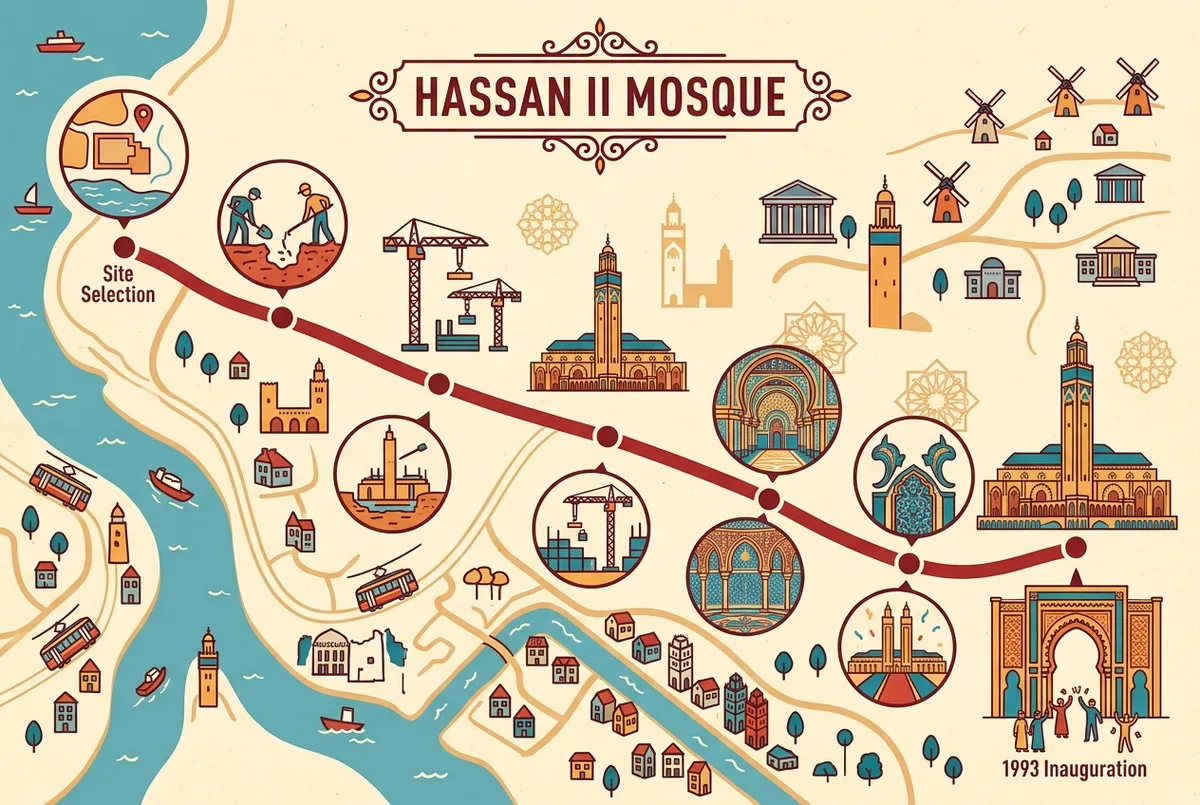
Construction began in 1986 and finished in 1993, making the project roughly seven years from groundbreaking to inauguration. The mosque officially opened on August 30, 1993, timed to coincide with the Prophet Muhammad’s birthday, a deliberate choice that underlined the religious significance of the building alongside its architectural ambition.
Seven years is a fast timeline for a structure of this scale, and it required thousands of workers and craftsmen operating around the clock in shifts. That pace is part of why hassan ii mosque details about its construction still impress architecture historians today, since few projects of comparable size and craftsmanship move that quickly without cutting corners on quality.
Why Did King Hassan II Commission the Mosque?
King Hassan II wanted a mosque grand enough to represent Morocco’s faith and identity to the world, choosing his own 60th birthday as the occasion and a site on the Casablanca coastline that let the building rise partly above the Atlantic itself. He is often quoted as wanting worshippers to reflect on a verse describing God’s throne as resting upon the water, a symbolic reason behind the mosque’s dramatic seaside placement.
Beyond personal symbolism, the project also served a practical purpose for the country. Morocco lacked a mosque of truly world-class scale at the time, and Casablanca, the nation’s largest and most commercially important city, had no landmark equivalent to the historic mosques of Fez or Marrakech. Hassan II Mosque filled that gap deliberately, becoming the spiritual and architectural centerpiece of a city better known internationally for business than heritage.
Why Build a Mosque Partly Over the Ocean?
Placing a building of this scale partly over the Atlantic Ocean was not a simple design flourish, it required engineers to construct a reinforced platform capable of withstanding tides, storms, and constant salt exposure decades before anyone worried about the building’s long-term maintenance. Crews drove deep foundation piles into the seabed and built out a stone jetty to support the esplanade and the section of the mosque that sits directly above the water.
That engineering challenge is one reason the project drew international contractors and consultants alongside Moroccan labor, since few construction teams anywhere had tackled a religious monument on this kind of marine foundation before. The payoff is part of what makes Hassan II Mosque instantly recognizable today: waves visibly break against the platform beneath the prayer hall during high tide, a detail no inland mosque, however historic, can offer visitors.
Hassan II Mosque Construction Timeline
Year
Milestone
1980s
Site selected on the Casablanca coastline; design commissioned from architect Michel Pinseau
1986
Construction begins, involving thousands of workers and skilled artisans
1987 to 1992
Structure, minaret, and interior craftsmanship completed in stages
August 1993
Mosque inaugurated, timed to the Prophet Muhammad’s birthday
The timeline above compresses years of specialized work, particularly the hand-carved cedar ceilings, zellige tilework, and marble finishing that could not be rushed even under an aggressive construction schedule. Much of that detail work continued even as other sections of the building were already structurally complete.
How Old Is Hassan II Mosque Today?
Since its 1993 inauguration, Hassan II Mosque has stood for more than three decades, making it a relatively young building by the standards of Morocco’s centuries-old historic mosques in Fez and Marrakech. Its hassan ii mosque age is exactly why it reads differently to visitors than older Moroccan religious sites: the craftsmanship follows traditional methods, but the building itself, its plumbing, its retractable roof mechanism, and its scale are thoroughly modern.
That relative youth also means the mosque was built with deliberate tourism and cultural diplomacy in mind, alongside its religious purpose. Few mosques anywhere combine such recent construction with the same depth of traditional artisan work, which is part of why it draws architecture-focused visitors as much as religious ones.
What Makes Hassan II Mosque’s Design Historic?
The mosque’s defining architectural feature, a retractable roof over the prayer hall that can open in minutes, was genuinely novel for a religious building of this scale when it was completed, and it remains one of the details every guide points out during a visit. Michel Pinseau paired that modern engineering with traditional Moroccan craftsmanship: carved cedar wood, hand-set marble, and detailed zellige mosaic tilework produced by thousands of local artisans.
That combination, modern structural ambition wrapped in centuries-old decorative technique, is what architecture historians usually cite as the mosque’s most historically significant contribution. For the full breakdown of the minaret, materials, and interior layout, read Hassan II Mosque architecture in full.
How Much Did the Mosque Cost, and Who Paid for It?
Historical accounts commonly cite a total construction cost in the hundreds of millions of dollars, financed largely through a nationwide public subscription in which ordinary Moroccan citizens contributed funds toward the project, alongside government and private support. That financing model, a national mosque genuinely part-funded by its own people, is a detail many visitors find as compelling as the building itself.
For roughly 25 years after its 1993 completion, Hassan II Mosque held the title of the largest mosque in Africa and one of the largest in the world by capacity, with its minaret standing as the tallest of any religious structure globally at the time. That record has since shifted, and the full current ranking, along with the real capacity figures, is covered in is Hassan II Mosque the largest mosque in Africa.
Regardless of where it ranks today, the mosque remains Morocco’s largest and most architecturally significant, and nothing about the visitor experience or the scale of what you see in person has changed.
Who Were the Craftsmen Behind Hassan II Mosque?
Thousands of Moroccan artisans worked on Hassan II Mosque alongside the construction crews, specializing in trades that take years to master: zellige mosaic cutting, hand carving of cedar wood brought down from the Middle Atlas mountains, intricate plasterwork known as gebs, and the fitting of marble sourced and shaped specifically for the project. Many of these craftsmen came from guilds in Fez and Meknes, cities with centuries of accumulated expertise in exactly this kind of decorative work.
Coordinating that many specialized trades on a single, fast-moving construction site was itself a historic undertaking. Guides who lead the interior tour today still point to specific ceilings or archways as examples of individual artisans’ signature techniques, a detail that turns a walk through the prayer hall into something closer to viewing a living catalog of Moroccan craft traditions than touring a single building.
What Role Does the Minaret Play in the Mosque’s History?
The minaret rises roughly 210 meters above the esplanade, making it one of the tallest religious structures ever built and, for many years after 1993, the tallest minaret in the world. A beacon near its summit was designed to project a beam of light toward Mecca after dark, a feature that became one of the mosque’s most recognizable nighttime details and a point of civic pride for Casablanca residents watching it from across the city.
That height was never just for spectacle. Pinseau’s design used the minaret as a structural and symbolic anchor for the entire complex, visible from ships approaching Casablanca’s port long before the rest of the building comes into view. For a closer look at the minaret’s construction and materials, see Hassan II Mosque architecture.
How Did Hassan II Mosque Become Casablanca’s Icon?
Casablanca is primarily known as Morocco’s commercial and port hub rather than a historic tourist city, and Hassan II Mosque is the single building that gave it a landmark to match cities like Marrakech or Fez. Its position directly on the Atlantic coastline makes it visible from far along the corniche, and its silhouette now appears on nearly every piece of Casablanca tourism marketing produced since the 1990s.
Three decades of steady visitor traffic, largely driven by its status as one of the only mosques in Morocco open to non-Muslim visitors, cemented that reputation further. According to Wikipedia’s entry on Hassan II Mosque, the building remains among the most visited religious sites in the country, drawing travelers who might otherwise pass through Casablanca without stopping at all.
Local pride in the mosque runs deep too, not just among tourism operators but among Casablanca residents who watched it rise on the coastline during their own childhoods or remember contributing to the public fundraising campaign themselves. That personal connection, a national landmark that ordinary citizens helped pay for, gives Hassan II Mosque a place in Moroccan cultural identity that goes well beyond its role as a photo stop on a travel itinerary. Many Casablanca families can point to a relative, a workplace, or a neighborhood association that took part in the original fundraising drive, a detail few other tourist landmarks anywhere can claim about their own construction history.
How Does Hassan II Mosque Compare to Other Historic Mosques?
Unlike the centuries-old mosques of Fez, Marrakech, or the wider Islamic world, Hassan II Mosque is a distinctly modern monument built with twentieth-century engineering and financing, yet it deliberately echoes design traditions that stretch back generations, from zellige geometric tilework to carved cedar screens found in older Moroccan religious buildings. That blend of new and old is precisely what historians point to when explaining why it earned landmark status so quickly compared with newer religious buildings elsewhere in the world.
Where older mosques accumulated their historic weight gradually, expanded and restored across centuries by successive rulers, Hassan II Mosque arrived essentially complete in a single seven-year push, with its historic significance established almost immediately upon opening rather than earned slowly over time. Its scale, cost, and engineering ambition, more than its age, are what secure its place in the broader history of religious architecture.
Hassan II Mosque Quick Facts
Detail
Description
Location
Casablanca, on the Atlantic coastline
Architect
Michel Pinseau (French)
Construction
1986 to 1993
Signature feature
Retractable roof over the prayer hall
Funding
Public subscription plus government support
Status
Morocco’s largest mosque, open to non-Muslim visitors on guided tours
These hassan ii mosque about-page basics cover the essentials, but each row links to a fuller breakdown elsewhere in this guide for readers who want the complete story behind any single detail.
What Has Changed at Hassan II Mosque Since 1993?
Beyond routine maintenance against constant salt-air exposure, the mosque’s core structure and interior craftsmanship have stayed remarkably close to their original 1993 form, a deliberate choice given how much specialized restoration work replacing hand-carved cedar or hand-set zellige would require. What has changed is the visitor experience around it: guided tour systems, online ticketing, and dedicated visitor entrances have all been added over the decades to manage steadily growing tourist numbers.
The surrounding esplanade and corniche area have also developed considerably since the 1990s, with cafes, promenades, and hotels now clustered near the mosque in a way that did not exist when it first opened. For directions, transport options, and everything built up around the site today, see Hassan II Mosque location.
Ready to See the History in Person?
Reading about the mosque’s history is one thing; standing beneath its carved cedar ceiling with a guide explaining the same details is another. Once you are ready to plan the visit itself, Hassan II Mosque tickets covers current prices, hours, and how to book, and Hassan II Mosque location covers exactly how to get there from anywhere in Casablanca or beyond. For a full side-by-side of every current tour and ticket option, the Hassan II Mosque homepage compares all seven products in one table.
Why Do Travelers Still Visit Hassan II Mosque Every Year?
More than three decades after its inauguration, Hassan II Mosque continues to draw a steady stream of travelers from Europe, North America, and across Morocco itself, most of them motivated by the same two things: the rare chance for non-Muslim visitors to enter a working mosque, and the sheer craftsmanship on display once inside. Cruise ship stopovers, airport layovers, and day trips from Marrakech all funnel a meaningful share of Casablanca’s total visitor traffic toward the mosque specifically.
That steady demand is also why the guided tour system has become so well organized compared with many religious sites open to tourists elsewhere in the world. Decades of visitor volume forced the mosque’s operators to build a genuinely efficient booking and entry process, one that today runs almost entirely online rather than through same-day walk-up lines alone.
Frequently Asked Questions
When was Hassan II Mosque built?
Construction ran from 1986 to 1993, with the mosque officially inaugurated on August 30, 1993, timed to the Prophet Muhammad’s birthday.
Why did King Hassan II build the mosque?
He commissioned it to mark his 60th birthday and to give Casablanca, and Morocco more broadly, a mosque grand enough to represent the country’s faith and identity on a world stage.
Who designed Hassan II Mosque?
French architect Michel Pinseau designed the mosque, working alongside thousands of Moroccan artisans who produced the cedar carving, marble work, and zellige tilework throughout the interior. Their combined work is what gives the mosque its reputation as a showcase of traditional Moroccan craft, not just a modern engineering feat.
How was Hassan II Mosque paid for?
Financing came largely from a nationwide public subscription, with ordinary Moroccan citizens contributing funds alongside government and private support, plus additional funding covered in the dedicated cost breakdown. That shared national investment is part of why the mosque still carries such strong civic pride today.
Is Hassan II Mosque older than Morocco’s other famous mosques?
No, it is younger than the historic mosques of Fez and Marrakech, which date back centuries. Hassan II Mosque is a relatively modern addition, completed in 1993, though its craftsmanship deliberately follows traditions passed down from those older buildings.