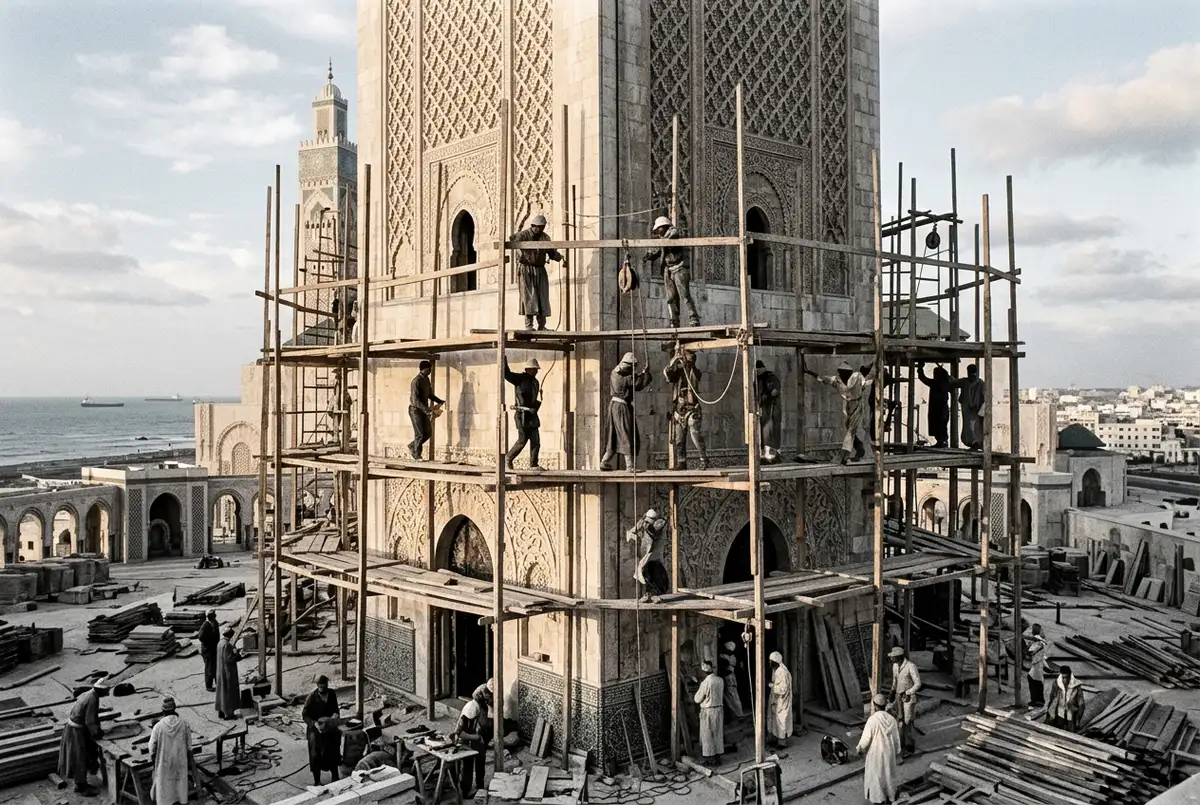
Historical accounts commonly cite a total Hassan II Mosque cost to build in the hundreds of millions of dollars, financed largely through a nationwide public subscription in which Moroccan citizens contributed funds, alongside government and private support.
The Hassan II Mosque cost to build ran into the hundreds of millions of dollars by most historical accounts, an enormous sum that was raised largely through a nationwide public subscription campaign rather than government funds alone. Ordinary Moroccan citizens, businesses, and institutions all contributed toward the project, a financing model that remains almost as notable as the building itself.
This guide covers how that budget was raised, what it actually paid for, and the construction timeline that turned the plans into a finished mosque in roughly seven years.
How Much Did Hassan II Mosque Actually Cost?
Widely cited historical estimates put the total cost in the hundreds of millions of dollars, though precise figures vary between sources since the full complex, the mosque itself, the Quranic school, the library, and the hammam, was never itemized publicly down to the last expense. What is consistently agreed on is the scale: this was one of the most expensive religious construction projects undertaken anywhere in the twentieth century.
Costs ran high for reasons beyond simple square footage. Sourcing and shaping marble, cedar, and other materials specifically for the project, engineering a structure partly over the Atlantic Ocean, and paying thousands of specialized artisans over several years all added significantly to the final bill compared with a standard building project of similar size.
How Was Hassan II Mosque Financed?
Financing came primarily through a nationwide public subscription, a fundraising campaign in which Moroccan citizens across the country contributed money toward the mosque’s construction, often through workplace or community collection drives. Government funds and private donations supplemented this public contribution, but the subscription model was the centerpiece of how the project was framed and funded.
That structure meant the mosque was not simply a royal commission paid for by state coffers alone, it was, in a real sense, a building the Moroccan public helped pay for directly. This detail is part of why the mosque carries such strong civic pride today, discussed further in the fuller Hassan II Mosque history.
How Did the Public Subscription Campaign Work?
The subscription campaign collected contributions from individuals, businesses, and institutions across Morocco, often organized through workplaces, local associations, and community collection drives rather than a single centralized fund. Amounts varied widely, from modest individual donations to larger sums from businesses eager to be associated with the project.
This grassroots structure was deliberate. Framing the mosque as a shared national undertaking, rather than purely a royal commission funded through the state budget, helped build public enthusiasm for a project of enormous scale and cost, and it gave millions of ordinary Moroccans a personal stake in a building most would eventually visit or pass by regularly.
Hassan II Mosque Construction Timeline
Year
Milestone
1980s
Site selected, architect Michel Pinseau commissioned, public subscription campaign launched
1986
Ground broken, main construction begins
1987 to 1992
Structural work, minaret construction, and decorative craftsmanship completed in stages
1993
Mosque hassan ii mosque built and inaugurated on August 30
The hassan ii mosque built date of 1993 marks the end of roughly seven years of construction, a fast pace for a project of this scale and decorative complexity, achieved through thousands of workers and artisans operating in coordinated shifts.
What Did the Budget Actually Pay For?
The bulk of the budget covered structural engineering for the ocean-facing foundation, the retractable roof mechanism over the prayer hall, and the enormous scope of decorative craftsmanship: hand-carved cedar ceilings, hand-set marble, and zellige mosaic tilework across the entire interior. Materials alone required significant investment, since much of the marble, wood, and metalwork was sourced and shaped specifically for this single project.
Labor made up a substantial share of costs too. Coordinating thousands of specialized artisans, many drawn from long-established craft guilds in Fez and Meknes, alongside standard construction crews, required a level of project management rarely needed for buildings of any kind, let alone one built on such an aggressive schedule. For the fuller design story behind what all that spending produced, see Hassan II Mosque architecture.
Was Hassan II Mosque Worth the Construction Cost?
Most historians and travelers who visit in person come away concluding yes, given the building’s status as one of the largest and most architecturally significant mosques built anywhere in recent history, and its role in defining Casablanca’s skyline for the past three decades. According to Wikipedia’s entry on Hassan II Mosque, it remains among the most visited religious landmarks in Morocco, a return on investment measured in decades of steady tourism and national pride rather than a simple balance sheet.
The public subscription financing model also changes how the cost question tends to land with Moroccan audiences specifically, since it was framed from the outset as a shared national project rather than a purely top-down expense. That context is worth keeping in mind alongside the raw figures.
How Does This Compare to Other Major Religious Buildings?
Very few religious buildings anywhere in the twentieth century matched Hassan II Mosque’s combination of scale, engineering ambition, and decorative craftsmanship, which is exactly why its cost ran so high relative to typical construction projects of similar square footage. Comparable modern mosques built since, including ones that have since surpassed it in size, have generally followed a similar pattern: high costs driven primarily by decorative craftsmanship and specialized engineering rather than by land or standard materials.
That pattern holds across most large-scale religious construction: the further a project pushes on engineering ambition, be it an ocean-facing foundation, a retractable roof, or a record-setting minaret, the more the budget shifts away from basic materials and toward specialized labor and custom-built solutions that cannot simply be bought off the shelf.
Did the Construction Budget Cover the Whole Complex?
The figures most often cited for Hassan II Mosque’s cost typically refer to the mosque building itself, but the wider complex also includes a Quranic school, a library, and a hammam, all built as part of the same overall project and funded from the same combined budget. Some historical estimates fold in these additional structures, which is part of why quoted totals can differ noticeably between sources.
Whichever figure a given source uses, the underlying scope was the same: a single coordinated construction effort covering the mosque, its supporting religious and cultural buildings, and the engineering needed to place much of it directly on the Casablanca coastline.
Ready to Visit What the Budget Built?
Numbers on a page rarely capture what thousands of artisans and hundreds of millions of dollars actually produced. See Hassan II Mosque tickets for current prices and booking, or start from the Hassan II Mosque homepage to compare every current tour option side by side.
What Would It Cost to Build Today?
Reproducing Hassan II Mosque’s level of craftsmanship today would almost certainly cost significantly more than the original historical figures, given how few artisans now practice hand-carved cedar work, traditional zellige cutting, and large-scale gebs plasterwork at the same volume and speed achieved during the original construction. Modern labor costs, stricter marine engineering standards for coastal construction, and inflation across decades would all push a comparable project’s budget well beyond the 1980s and 1990s totals.
This is one reason architecture historians treat Hassan II Mosque as something close to a one-time achievement rather than a template easily repeated. The specific combination of available artisan labor, a public subscription willing to fund a project of this scale, and a construction timeline compressed to seven years is difficult to recreate under current economic and labor conditions.
What Happened to the Money After Construction Finished?
Once the mosque opened in 1993, ongoing maintenance costs, cleaning and restoring the marble and cedar surfaces, servicing the retractable roof mechanism, and protecting metalwork against the coastal salt air, shifted from a one-time construction budget to a recurring upkeep expense. That distinction rarely makes it into casual conversations about hassan ii mosque built costs, since most sources focus only on the original construction total rather than what it takes to preserve a building of this scale year after year.
Upkeep on a structure built directly on the Casablanca coastline is not a minor line item either. Salt air, ocean spray, and the sheer scale of the complex mean the same specialized craftsmanship that built the mosque is periodically needed again just to maintain it, a detail that underscores how unusual the original construction budget really was.
Frequently Asked Questions
How much did Hassan II Mosque cost to build?
Historical accounts commonly cite a total cost in the hundreds of millions of dollars, though exact figures vary since the full complex was never itemized publicly in detail.
Who paid for Hassan II Mosque?
Financing came largely from a nationwide public subscription campaign, with Moroccan citizens, businesses, and institutions contributing funds alongside government and private support.
When was Hassan II Mosque built?
Construction ran from 1986 to 1993, with the mosque officially inaugurated on August 30, 1993.
Why did construction cost so much compared to other buildings?
Sourcing and shaping specialized materials, engineering a structure partly over the ocean, and paying thousands of skilled artisans over several years all drove costs well above a standard construction project of similar size.
Is Hassan II Mosque still considered good value for what it cost?
Yes, most historians and visitors view it as a worthwhile investment, given its lasting role as Morocco’s most visited religious landmark and Casablanca’s defining architectural icon.
Hassan II Mosque Skip-the-Line Entry Ticket with Guided Tour